
Business Growth · Branch Operations · ERP Reporting
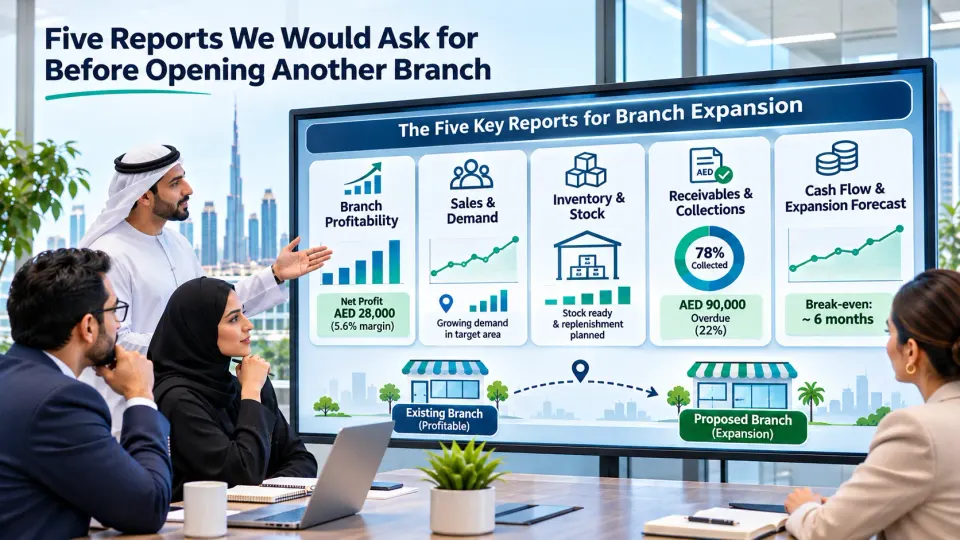
Opening another branch can look like the natural next step when sales are growing. But before committing to a new location, we would want to understand five things: whether the existing branch is profitable, whether demand exists in the proposed area, whether stock can support the expansion, whether customers are paying on time, and whether the business has enough cash to fund the move.
Expansion is more than finding a suitable property and preparing a new team. It adds rent, salaries, utilities, inventory requirements, logistics costs and working-capital pressure. A business can be growing in revenue and still be unprepared to carry those additional commitments.
That is why we would begin with reports rather than assumptions. The following five reports provide a practical starting point for businesses considering another branch in the UAE or elsewhere in the region.
In this article
- Branch profitability
- Sales and demand
- Inventory and stock
- Receivables and collections
- Cash flow and expansion forecast
- Bringing the reports together
- How ERPNext helps
- Management checklist
1. Branch Profitability Report: Is the Existing Branch Actually Profitable?
A branch can generate strong revenue and still contribute very little to the overall business. Sales figures alone do not tell us whether the location is financially healthy. We would start with a branch-wise Profit and Loss statement to understand what remains after the cost of goods sold and operating expenses.
Consider this illustrative monthly example for an existing trading branch:
| Item | Amount (AED) |
|---|---|
| Sales revenue | 500,000 |
| Sales returns and discounts | (20,000) |
| Net sales | 480,000 |
| Cost of goods sold | (355,000) |
| Gross profit (26.0%) | 125,000 |
| Salaries and benefits | (45,000) |
| Rent and utilities | (25,000) |
| Delivery and transport | (12,000) |
| Marketing | (8,000) |
| Other operating expenses | (7,000) |
| Operating profit (5.8%) | 28,000 |
Illustrative figures only. Actual branch profitability depends on the company's accounting policies, cost allocation and transaction records.
The branch generates AED 480,000 in net sales, but its operating profit is AED 28,000. That is a much smaller contribution than the headline sales figure might suggest.
Before opening another location, management should ask:
- Is the existing branch consistently profitable across several months?
- Are rent, payroll and delivery costs increasing faster than revenue?
- Are shared head-office expenses allocated fairly?
- Does the branch remain profitable after discounts, returns and other operating costs?
- Can the same operating model realistically be repeated at another location?
Why this report matters: It helps management distinguish between a branch that generates high sales and one that makes a sustainable financial contribution.
In ERPNext, the Profit and Loss Statement can be filtered using Cost Centers and other accounting dimensions when transactions are tagged consistently. The Cost Center structure can help organise reporting by branch, department or business unit.
For a practical overview of the setup decisions involved, see our guide to ERPNext multi-company and multi-branch management in the UAE.
Important reporting distinction: A Cost Center-filtered Profit and Loss report does not automatically provide a complete branch-level Balance Sheet. If management needs branch-level asset and liability reporting, the accounting dimensions and transaction tagging must be designed accordingly. Shared costs also need an agreed allocation method.
2. Sales and Demand Report: Is There Enough Demand for Another Location?
A profitable existing branch does not automatically prove that a second location will succeed. The next question is whether customers in the proposed area have enough demand for the products or services the business offers.
We would review sales by product, customer, customer group and geographic area. The aim is to understand where revenue is coming from, which products are moving consistently and whether the business is already serving customers who are located closer to the proposed branch.
Useful indicators include:
- Sales by territory: Identify locations that already generate meaningful customer activity.
- Sales by item or product group: Understand which products contribute most to revenue and margin.
- Customer concentration: Check whether growth depends heavily on a small number of customers.
- Order frequency: Distinguish repeat demand from occasional large transactions.
- Unfulfilled demand: Review orders that are delayed, partially delivered or difficult to serve from the current location.
For example, a distributor may notice that a growing share of orders comes from customers in another emirate. That could indicate an opportunity to improve service through a local branch. However, it could also be more economical to improve delivery routes or use a different warehouse arrangement.
Historical sales are evidence of existing activity, not proof of future market demand. Before committing to a lease, compare sales data with customer enquiries, lost opportunities, competitor presence, local market research and the cost of serving the area from the current branch.
ERPNext provides sales reports that can be used to analyse performance by customer, item, territory and salesperson. See the official ERPNext Sales Reports and Analytics documentation for the available reporting options.
Businesses operating across multiple locations may also find our overview of multi-location management with ERPNext useful.
3. Inventory and Stock Report: Can We Supply the New Branch Efficiently?
A new branch needs more than a sales target. It needs stock that is available at the right time, in the right quantities and at a manageable cost.
Opening a location without reviewing inventory can create two problems. The business may transfer too much stock and tie up cash in slow-moving items, or it may transfer too little and lose sales because popular products are unavailable.
We would review:
- Stock by warehouse: Understand where inventory is physically held.
- Fast-moving and slow-moving items: Identify products that need regular replenishment and those that may create excess stock.
- Reserved quantities: Separate stock already committed to customer orders from stock that is genuinely available.
- Reorder levels: Review minimum stock levels and replenishment lead times.
- Ageing and obsolete stock: Identify inventory that may be difficult to sell or transfer.
- Transfer and replenishment costs: Estimate the operational cost of supplying the proposed location.
Imagine that the existing warehouse holds 1,000 units of a product. That number alone does not mean all 1,000 units are available for the new branch. Some may already be reserved for confirmed orders, while others may be damaged, held for inspection or required to maintain safety stock at the current location.
ERPNext's Stock Level and Projected Quantity reports can help users review actual, planned, requested, ordered and reserved quantities. The Stock Ledger can help trace the movements behind inventory balances.
Why this report matters: It helps management estimate how much additional stock is genuinely needed, what can be transferred and where replenishment could put pressure on working capital.
For trading and distribution businesses, inventory planning should be connected to purchasing, warehouse operations and sales commitments. Explore our ERPNext solutions for trading companies for more information.
4. Receivables and Collections Report: Are We Collecting the Money We Have Earned?
Revenue recorded in the accounts is not the same as cash received in the bank. If a business sells on credit, it may report strong sales while a significant amount of money remains tied up in customer invoices.
That becomes particularly important before expansion. A new branch may require deposits, fit-out expenses, salaries, utilities and additional inventory before it starts generating enough cash to support itself.
We would review the Accounts Receivable ageing report to understand how much customers owe and how long those balances have remained outstanding.
Here is an illustrative example:
| Receivable ageing | Amount (AED) |
|---|---|
| Current / not yet due | 180,000 |
| 1–30 days overdue | 90,000 |
| 31–60 days overdue | 70,000 |
| 61–90 days overdue | 35,000 |
| More than 90 days overdue | 25,000 |
| Total receivables | 400,000 |
Illustrative customer receivables ageing. Overdue balances total AED 220,000.
In this example, more than half of the outstanding receivables are overdue. Before committing to another branch, management should understand why those payments are delayed and how much of the balance is realistically collectible.
Questions worth investigating include:
- Which customers have the largest overdue balances?
- Are delays concentrated among a few customers or spread across the customer base?
- Are credit limits and payment terms appropriate?
- Are collection follow-ups happening consistently?
- Are disputed invoices or unallocated payments affecting the reported balances?
The official ERPNext Accounts Receivable and Payable documentation explains how outstanding invoices and ageing can be reviewed.
Reporting consideration: If receivables are analysed by branch or another accounting dimension, the relevant invoice and payment records need consistent dimension values. Otherwise, a filtered report may not present the complete collection position.
A branch expansion decision should consider expected collections, not just invoiced sales. A business that improves collections may be in a stronger position to fund expansion without relying entirely on additional borrowing.
5. Cash Flow and Expansion Forecast: Can We Fund the Investment?
The final report brings the previous four areas together: cash flow. Even when a business is profitable, expansion can create a temporary cash shortage if the investment and operating costs arrive before the new branch generates sufficient income.
We would separate the review into two parts.
Part A: Review Actual Cash Flow
Start by understanding how cash has moved through the existing business. Review operating, investing and financing activities, along with movements in receivables, payables and inventory.
This helps answer questions such as:
- Is day-to-day business generating enough cash?
- Are customers paying within the expected period?
- Is inventory consuming more cash than planned?
- Are supplier payments putting pressure on available funds?
- Does the business depend on borrowing or owner funding to cover regular expenses?
ERPNext's Cash Flow Report helps explain actual cash movement through operating, investing and financing activities.
Part B: Prepare a Forward-Looking Expansion Forecast
A historical Cash Flow report does not automatically predict the financial impact of a new branch. Management should prepare a separate forecast using realistic assumptions about the proposed location.
Include costs such as:
- Rental deposit, advance rent and fit-out expenses.
- Licensing, registration and other setup costs.
- Furniture, equipment, technology and utilities.
- Recruitment, salaries, training and staff-related costs.
- Opening inventory and replenishment requirements.
- Marketing, delivery and ongoing operating expenses.
- Expected sales ramp-up, customer payment terms and collection delays.
Build at least three scenarios: a conservative case, an expected case and an optimistic case. The conservative case is especially useful because a new branch may take longer than expected to attract customers and reach its target sales level.
Why this report matters: It helps management estimate the cash required before the new branch becomes self-supporting and identify how much financial headroom the existing business can safely provide.
6. Bringing the Five Reports Together
Each report answers a different question, but none should be reviewed in isolation. A strong sales trend may be less attractive if margins are shrinking. A large stock balance may not be useful if most of it is slow-moving. A profitable branch may still struggle to fund expansion if collections are delayed.
We would bring the five reports into one management review:
| Report | Key question | Decision it supports |
|---|---|---|
| Branch profitability | Does the current branch generate a sustainable contribution? | Whether the existing model is worth replicating. |
| Sales and demand | Is there sufficient demand in the proposed area? | Where and how to expand. |
| Inventory and stock | Can the business supply another location? | How much stock to transfer or purchase. |
| Receivables and collections | How much invoiced revenue has actually been collected? | Whether collection performance can support growth. |
| Cash flow and forecast | Can the business fund setup and early operating costs? | When to invest and how much funding is required. |
The management discussion should also consider factors that reports cannot fully answer on their own: location suitability, competitor activity, staffing availability, customer access, local operating costs and regulatory requirements.
The purpose is not to find five positive numbers. It is to understand the risks and trade-offs before making a long-term commitment.
7. How ERPNext Helps Bring Branch Information Together
When sales, inventory, purchasing and accounting records are maintained in separate systems, preparing a reliable expansion review can become a manual exercise. Teams may spend hours collecting spreadsheets, checking figures and reconciling different versions of the same information.
ERPNext can help bring relevant operational and financial records into a connected system. Depending on the business structure and configuration, management can use reports and dimensions to review activity across companies, branches, warehouses and departments.
For example:
- Sales reports can help compare performance by customer, item and territory.
- Cost Centers and accounting dimensions can support configured branch-level income and expense analysis.
- Warehouse reports can show stock availability and movement by location.
- Accounts Receivable can help finance teams review outstanding customer balances.
- Profit and Loss and Cash Flow reports can support financial reviews.
- Dashboards can bring selected performance indicators into a shared management view.
Explore our resources on ERPNext reporting and dashboards and ERPNext implementation to understand how connected reporting can support business decisions.
It is important to design the reporting structure before relying on it. A Company in ERPNext generally represents an accounting entity, while a warehouse represents a stock location. Cost Centers and Accounting Dimensions can support management analysis. The right arrangement depends on legal ownership, tax registration, stock ownership, banking and reporting requirements.
For a group with separate legal entities, management may also need intercompany processes and consolidated reporting. For a single legal entity with multiple operating locations, a different structure may be more appropriate. These choices should be reviewed during ERP discovery rather than decided only by copying the organisation chart into the software.
Our guide to multi-company and multi-branch management explains these distinctions in more detail.
8. Management Checklist Before Opening Another Branch
Before approving the investment, we would want management to be comfortable with the following questions:
- Have we reviewed the existing branch's profitability over a meaningful period?
- Do we understand the demand and customer profile in the proposed location?
- Have we checked stock availability, reserved quantities and replenishment lead times?
- Are customer collections happening within acceptable timeframes?
- Have we estimated the full setup cost and ongoing operating expenses?
- Have we prepared conservative, expected and optimistic cash-flow scenarios?
- Do we know who will manage the new branch and how performance will be measured?
- Can the existing systems provide consistent reporting across locations?
If several answers remain unclear, it may be worth improving the reporting process or validating the business case before signing a lease or committing to additional stock.
Make Your Next Branch a Data-Backed Decision
Expansion should be supported by a clear view of profitability, demand, inventory, collections and cash flow. When these records are connected, management can spend less time reconciling spreadsheets and more time evaluating the business decision.
At Craft Interactive, we help businesses review their processes, structure ERPNext reporting and connect operational information across teams and locations.
Talk to Craft Interactive about your ERPNext requirements or explore our ERPNext implementation services.
Further Reading and Official References
- ERPNext – Profit and Loss Report
- ERPNext – Cost Center
- ERPNext – Sales Reports and Analytics
- ERPNext – Stock Level Report
- ERPNext – Stock Ledger
- ERPNext – Accounts Receivable and Payable
- ERPNext – Cash Flow Report
- ERPNext – Understanding Financial Statement Reporting
ERPNext functionality and report availability may vary by version, installed applications and configuration. Financial reporting should be reviewed with the organisation's accounting team. This article provides general business and implementation guidance, not financial, tax or legal advice.