
Process map · Construction
Project to bill in a construction company
A contractor's project to bill starts with a tender and a bill of quantities and ends with a final account, sometimes long after the site is handed over. In between come site material requests, subcontractors, monthly progress invoices, variations and retention money. The pain is nearly always the same: the cost of the job is known in accounts, the progress is known on site, and the two meet too late. This map follows a contracting company on ERPNext.
The full map is free
16 steps, 2 decisions, 1 road into another map. Sign in once to open every approval and branch, larger ERPNext screens and a printable sheet.
Select a step to see who does it, the document and the ERPNext screen.
Step by step
-
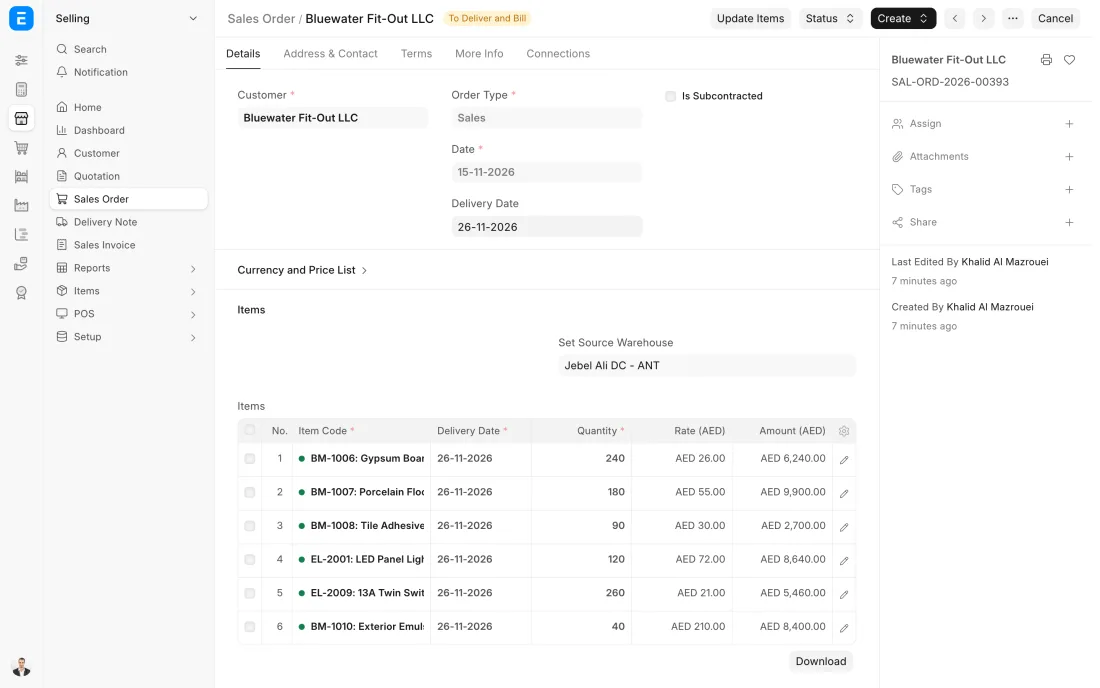
When the client awards the job, the accepted Quotation becomes the Sales Order. It carries the contract value line by line, as priced in the bill of quantities, and the payment terms. An advance payment from the client is recorded against it.
- Who does it
- Quantity surveyor
- Document that comes out
- Sales Order
ERPNext then does this by itself
- BOQ lines and rates carry over from the tender
- The order shows how much of each line is billed so far
- The advance is kept against the order until it is recovered
Without an ERP
The signed contract is filed in a cabinet. Accounts bills from a summary sheet, and the advance is never recovered properly from the monthly invoices.
ERPNext 16 · Sales Order -
A Project is created from the Sales Order with its dates and estimated cost. A budget can be set against the project by type of cost, and ERPNext can be set up to warn or stop when a request or order would go over it.
- Who does it
- Project manager
- Document that comes out
- Project
ERPNext then does this by itself
- Tasks for the usual stages come from the project template
- Costs booked to the project are compared with its budget
- The project is linked to the contract and the client
Without an ERP
The budget is a page in the tender file. The site keeps ordering, and the overspend on steel is discovered when the supplier's statement arrives.
-
At the end of the month, or at a milestone, the work done is measured against each line of the contract as a percentage or a quantity. The valuation goes to the client's consultant, who certifies the amount that may be invoiced.
- Who does it
- Quantity surveyor
- Document that comes out
- Certified valuation
ERPNext then does this by itself
- The project's percent complete follows its tasks
- The Sales Order shows what was billed in earlier months
Without an ERP
The valuation is rebuilt every month from last month's spreadsheet. One wrong formula carries forward, and the previously billed figure no longer agrees with the invoices.
-
A Sales Invoice is made against the Sales Order for the share of each line that has been certified. Part of the advance is deducted. Retention can be set up as a payment term on the invoice, so that share is not chased until it is due.
- Who does it
- Accountant
- Document that comes out
- Sales Invoice
ERPNext then does this by itself
- The Sales Order shows what is billed and what is left
- The invoice carries the TRN and 5% VAT
- The project's billed amount goes up
Without an ERP
The invoice is built from a spreadsheet of hours. Some hours are billed twice, some never, and the customer disputes the whole invoice over one line.
-
At completion the final quantities and all variations are agreed with the client, and the last invoice is raised for the balance. The project's cost is set beside its billing to show the margin, and the project is marked completed.
- Who does it
- Quantity surveyor
- Document that comes out
- Final Sales Invoice
ERPNext then does this by itself
- Time, purchase, material and expense costs are totalled on the project
- Billed amount and gross margin are worked out
- A completed project leaves the list of open jobs
Without an ERP
The final account drags on for a year because nobody kept a record of the variations. The contractor settles for less to get it closed.
-
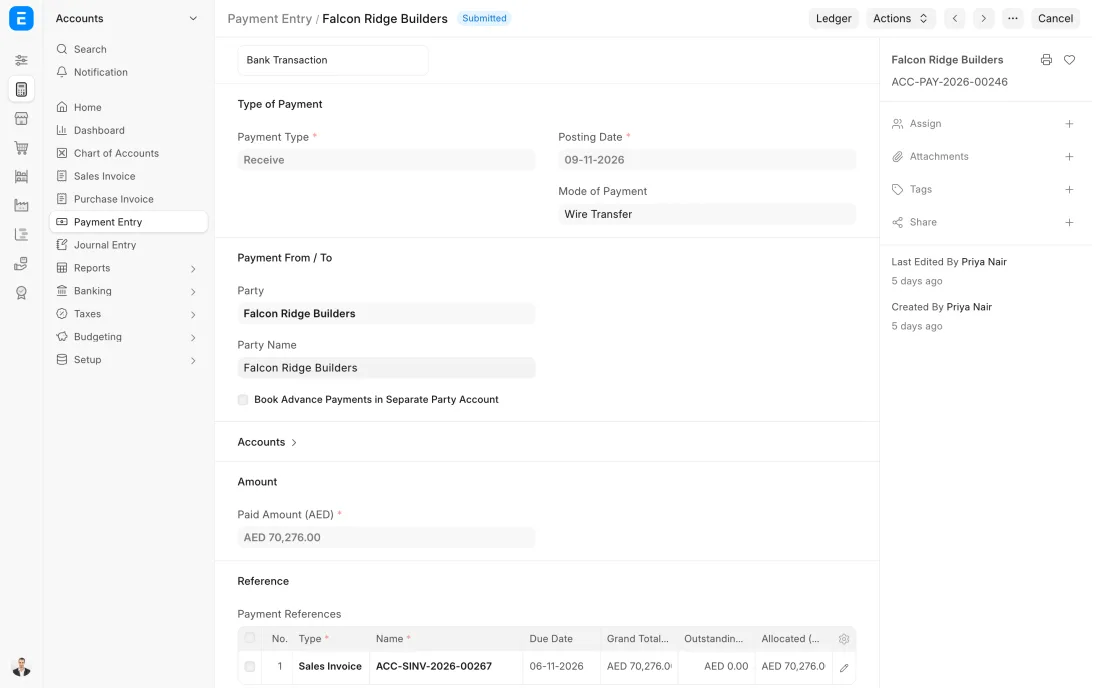
The retention held by the client falls due at handover or at the end of the defects period, as the contract says. Accounts sees it as an open amount with its due date, claims it, and records the payment when it arrives.
- Who does it
- Accountant
- Document that comes out
- Payment Entry
ERPNext then does this by itself
- Retention shows in receivables with its own due date
- The invoices are marked fully paid when it is received
Without an ERP
Retention from a job finished two years ago is forgotten, because the person who knew about it has left. The money is simply never claimed.
ERPNext 16 · Payment Entry (Receive)
The Full map adds 10 more steps: the approvals, checks and branches between these.
A contractor wins the fit-out of an office floor. The priced bill of quantities becomes the Sales Order, the site asks for materials against the project, the client is invoiced each month for the work certified, and the retention is collected after the defects period.
What changes in a construction company. The same process, the steps this industry really uses.
-
The price is a bill of quantities
The job is priced line by line with quantities and rates. Standard ERPNext has no separate bill of quantities document, so it is usually kept as the item lines of the Quotation and Sales Order, or added as a small customisation when sections and long lists are needed.
-
Billing follows progress, not delivery
The client is invoiced each month, or at each milestone, for the work certified so far. Each Sales Invoice is made against the Sales Order, so the order shows what is billed and what is left.
-
Retention is held back and released later
The client keeps back a share of every invoice until handover or the end of the defects period. This can be set up with payment terms or a separate retention account, so the money stays visible until it is collected.
-
Subcontractors carry part of the work
Packages given to subcontractors are ordered and invoiced against the project. Their cost sits on the job beside the contractor's own labour and materials.
-
Changes are priced as variations
Work the client adds or changes is quoted and confirmed as an additional order on the same project. It is billed with the rest and never lost in the final account.
Where this map leads
Processes feed each other. Follow the work into the next map.
Free tool
Build your company's map
Pick your industry and the processes you run. Get one printable document with every map and step, ready to show your team or your ERP partner.
- Project to bill
- Purchase to pay
- Hire to retire
- Inventory management
- Month-end close
Questions about project to bill
Ask us anything elseDoes ERPNext have a bill of quantities (BOQ) for construction?
How is retention money handled in ERPNext?
How does progress billing work in ERPNext?
How are variations recorded in ERPNext?
See this process run on your own data
A 45-minute ERPNext demo that follows this map with an example from your business.