
Process map · Trading
Month-end close in a trading company
In a trading company most of the balance sheet is stock, and most of the profit is the difference between what the stock cost and what it sold for. So the close is mainly about getting the cost of stock right: freight and duty added, slow items provided for, foreign supplier balances restated. This map follows that version, with a result for each branch at the end.
The full map is free
18 steps, 2 decisions, 2 roads into other maps. Sign in once to open every approval and branch, larger ERPNext screens and a printable sheet.
Select a step to see who does it, the document and the ERPNext screen.
Step by step
-
The accountant checks that every delivery note and goods receipt of the month is submitted and dated inside it, in every branch. Goods delivered but not yet invoiced, and goods received with no supplier invoice, are read from their own reports so that sales and purchases fall in the right month.
- Who does it
- Accountant
ERPNext then does this by itself
- Each document posts to the month of its posting date
- Goods delivered but not billed, and received but not billed, show in their own reports
Without an ERP
Goods leave on the 31st and are invoiced on the 3rd. The sale is in one month and the stock reduction in another, and both months show the wrong margin.
-
The statement of each bank account is imported and matched line by line with the payments and receipts in the books, up to the last day of the month. Bank charges and interest that appear only on the statement are entered from the same screen.
- Who does it
- Accountant
- Document that comes out
- Reconciled bank accounts
ERPNext then does this by itself
- Likely matches are suggested by amount, date and reference
- The balance in the books shows beside the balance on the statement
- Matched payments get their clearance date
Without an ERP
The cash figure in the balance sheet is the ledger's balance, not the bank's. Uncleared cheques and missed bank charges hide inside it for months.
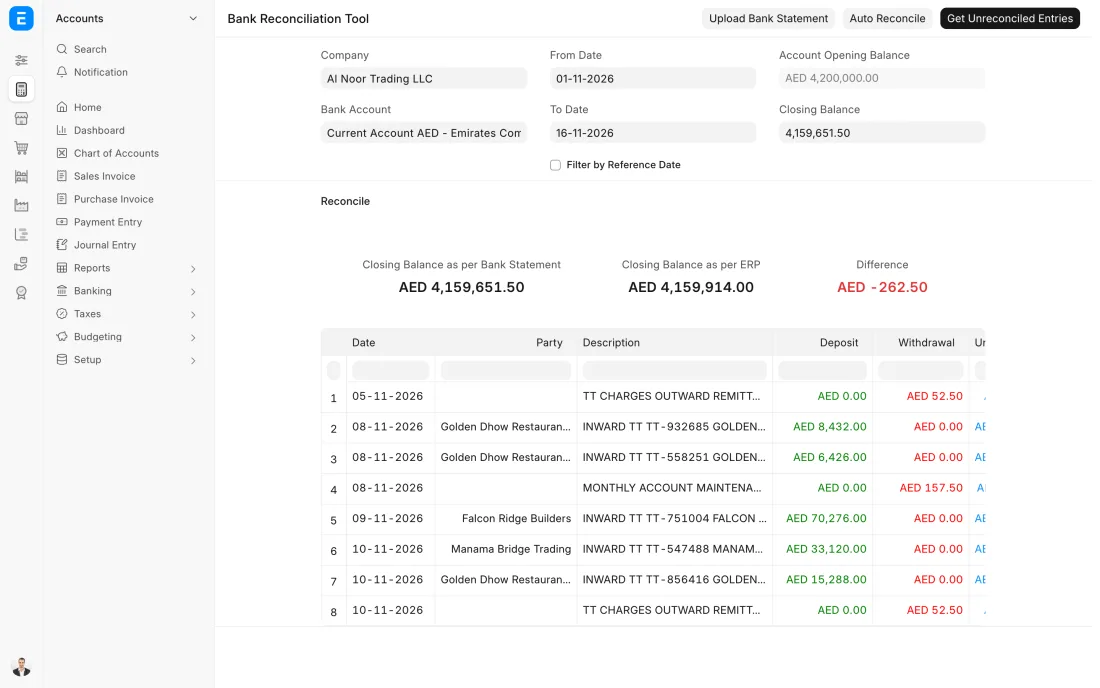
ERPNext 16 · Bank Reconciliation Tool -
Costs that belong to the month but have no invoice yet are accrued by Journal Entry: utilities, commissions, audit fees. Payments made in advance, such as rent and insurance, are spread so each month carries its share. Corrections between accounts are posted the same way, each with a remark that explains it.
- Who does it
- Accountant
- Document that comes out
- Journal Entry
ERPNext then does this by itself
- A repeating entry can be set up to be created every month
- An accrual can be reversed in the next month from the entry itself
- Each entry keeps who posted it and when
Without an ERP
The yearly insurance premium lands in one month and makes it look like a loss. Rent paid by the quarter does the same, and nobody trusts a single month's profit.
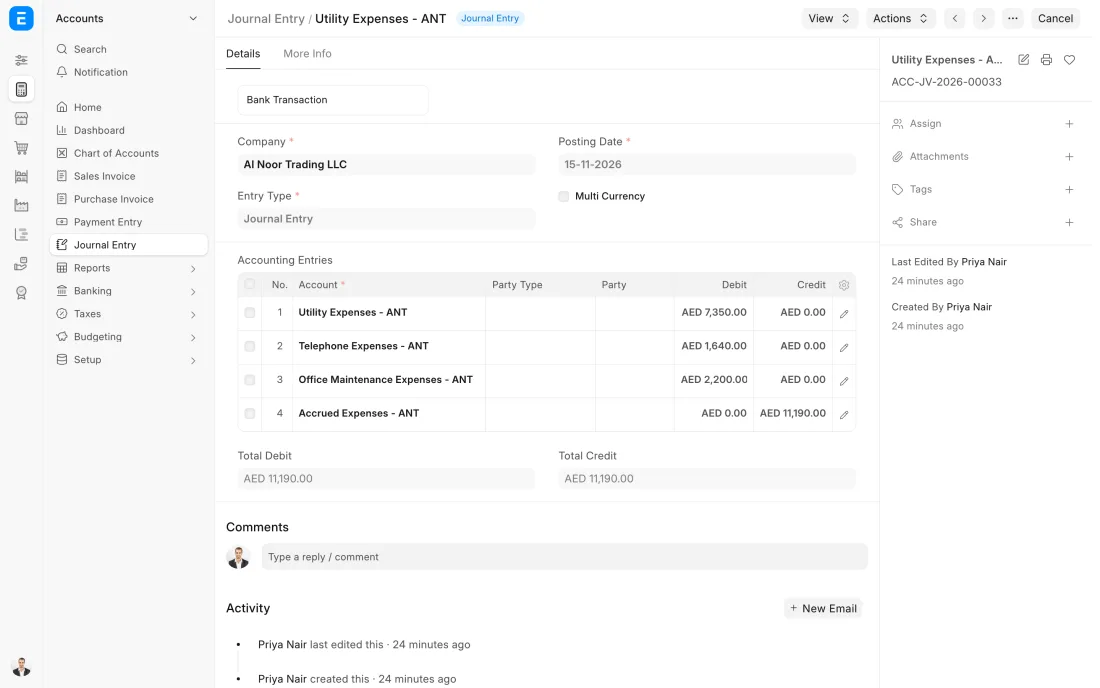
ERPNext 16 · Journal Entry -
The Trial Balance for the month is read line by line against the month before. The accountant looks for balances on the wrong side, suspense and clearing accounts that should be nil, and expense lines that jumped or vanished. Any figure opens into the entries behind it.
- Who does it
- Accountant
- Document that comes out
- Trial Balance
ERPNext then does this by itself
- Opening balance, movement and closing balance show for every account
- Debits always equal credits, because every entry is posted in pairs
Without an ERP
The trial balance is assembled in a spreadsheet from exported ledgers. A formula misses a row, and the difference is pushed into a suspense account to make it balance.
-
Once the figures are agreed, the month is closed with an Accounting Period, which stops new sales, purchase, payment and journal documents being dated inside it. The accounts can also be frozen up to a date, so only one trusted role can post earlier. At the end of the financial year, a Period Closing Voucher moves the year's profit or loss to retained earnings.
- Who does it
- Finance manager
- Document that comes out
- Accounting Period
ERPNext then does this by itself
- A document dated inside a closed period is refused with a message
- Only the role you name can post before the frozen date
Without an ERP
Someone back-dates an invoice into a month that was already reported. The figures the owner saw no longer match the system, and nobody notices until the audit.
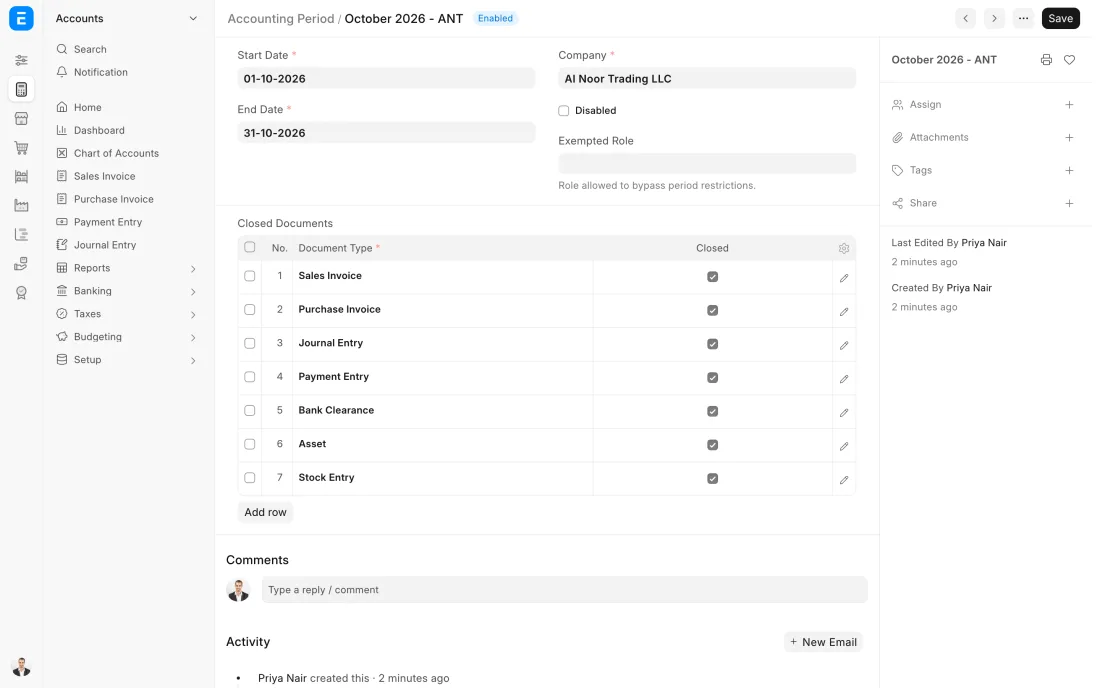
ERPNext 16 · Accounting Period (closed) -
The Profit and Loss is run for the company and then for each branch, using the branch's cost centre. Sales, margin and expenses of the branches are set side by side, with the Balance Sheet and Cash Flow for the whole company. The pack goes to the owners as a PDF or a spreadsheet.
- Who does it
- Finance manager
- Document that comes out
- Profit and Loss, Balance Sheet and Cash Flow
ERPNext then does this by itself
- All reports are built from the same ledger, so they agree with each other
- Any figure opens into the accounts and entries behind it
- A report can be set up to be emailed on a schedule
Without an ERP
The company makes a profit as a whole, so nobody sees that one branch has lost money every month since it opened.
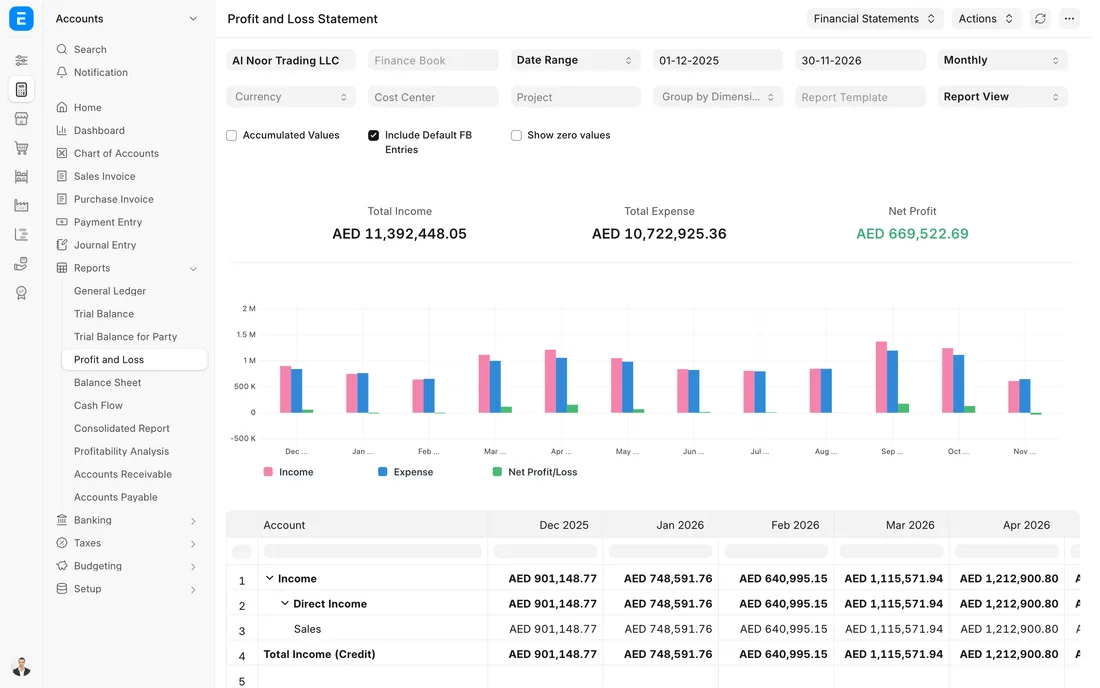
ERPNext 16 · Profit and Loss report
The Full map adds 12 more steps: the approvals, checks and branches between these.
A container from Europe is received on the 25th and half of it is sold by month end. The clearing agent's invoice is added to the cost of the goods before the close, so the margin on the half that was sold is the real one.
What changes in a trading company. The same process, the steps this industry really uses.
-
Stock value depends on landed cost
Freight, customs duty and clearing charges are added to the cost of the goods they belong to before the month is closed. Otherwise stock is too cheap and the margin too good.
-
Slow stock is provided for
The Stock Ageing report shows what has not moved. A provision for slow and obsolete items is posted every month, not found in one painful write-off.
-
Foreign supplier balances are restated
What is owed in other currencies is brought to the month-end rate, so exchange gains and losses land in the month they arise.
-
Each branch gets its own result
Sales, cost of goods and expenses carry the branch's cost centre, so the same close produces a profit and loss for every branch.
Where this map leads
Processes feed each other. Follow the work into the next map.
Free tool
Build your company's map
Pick your industry and the processes you run. Get one printable document with every map and step, ready to show your team or your ERP partner.
- Month-end close
- Order to cash
- Purchase to pay
- Inventory management
- VAT return
Questions about month-end close
Ask us anything elseDo landed costs have to be entered before we close the month?
How do I revalue foreign currency balances at month end in ERPNext?
Can ERPNext show profit and loss for each branch?
See this process run on your own data
A 45-minute ERPNext demo that follows this map with an example from your business.