
Process map · Manufacturing
Hire to retire in a manufacturing company
A factory runs on shifts, and most of its people are paid for the days and hours they are really there. Hire to retire in manufacturing is therefore mostly about three things: who is on which shift, what the device at the gate says about attendance, and how overtime reaches the payslip without a supervisor's notebook in between. This map follows that version.
The full map is free
16 steps, 1 decision, 1 road into another map. Sign in once to open every approval and branch, larger ERPNext screens and a printable sheet.
Select a step to see who does it, the document and the ERPNext screen.
Step by step
-
The chosen applicant gets a Job Offer with the designation, salary and terms, printed on your letterhead from a template. The offer is marked accepted or rejected when the candidate answers.
- Who does it
- HR officer
- Document that comes out
- Job Offer
ERPNext then does this by itself
- The offer letter is filled in from the applicant and the offer terms
- An accepted offer carries into onboarding and the employee record
- Offers still waiting for an answer are listed
Without an ERP
The offer letter is last year's file with the name changed. The old salary is still in paragraph three, and the candidate signs it.
-
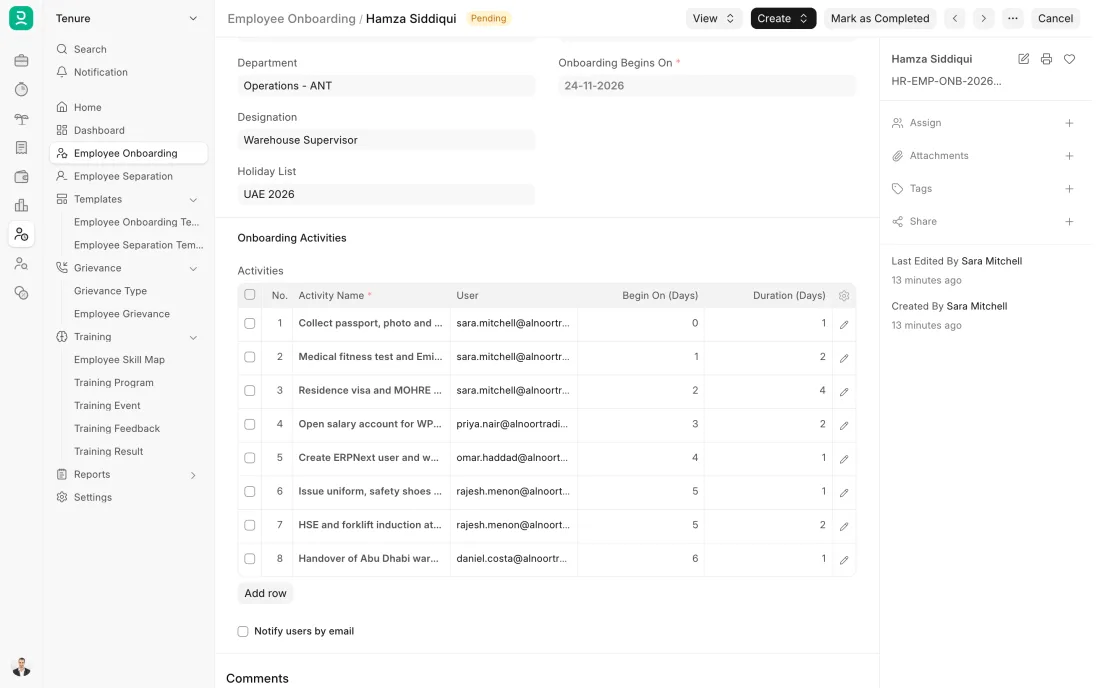
The Employee Onboarding template for the shop floor adds what a factory needs: safety induction, protective equipment, machine training and the first shift. The Employee record is created with the joining date and department, a Salary Structure Assignment gives them their pay, and document expiry dates can be set up as fields with reminders.
- Who does it
- HR officer
- Document that comes out
- Employee Onboarding, Employee
ERPNext then does this by itself
- Each activity becomes a task for HR, the safety officer or the supervisor
- Onboarding shows as complete only when every task is done
- The salary structure assigned to the employee is what payroll uses
Without an ERP
A new operator is put on the line on day one because the shift is short. The safety induction is planned for next week, and next week never comes.
ERPNext 16 · Employee Onboarding -
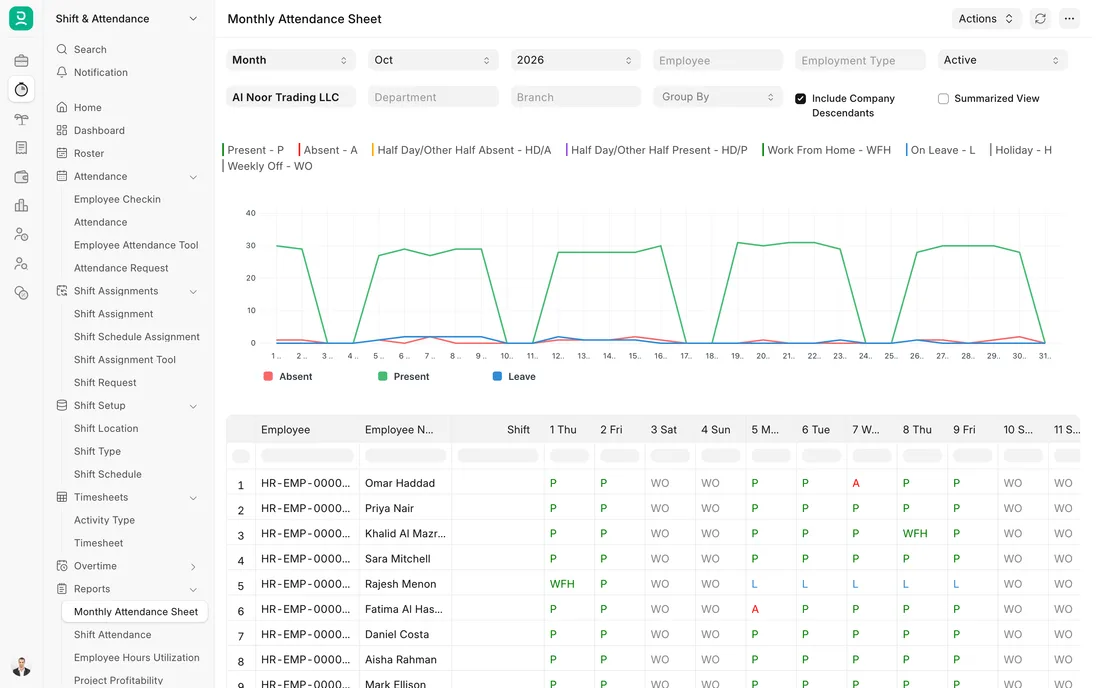
Workers punch in and out on a biometric device, which can be set up to send each punch to ERPNext as an Employee Checkin. Each check-in is matched to the worker's shift, so a night shift that ends the next morning still counts as one working day.
- Who does it
- Employee
- Document that comes out
- Employee Checkin, Attendance
ERPNext then does this by itself
- Check-ins become present, half day or absent by the shift's rules
- Late arrivals and early exits are flagged against the shift times
- Hours worked are worked out from the check-in and check-out times
Without an ERP
The supervisor fills in a muster sheet at the end of the shift. Friends sign for each other, the sheet reaches HR a week late, and nobody can check any of it.
ERPNext 16 · Monthly attendance sheet -
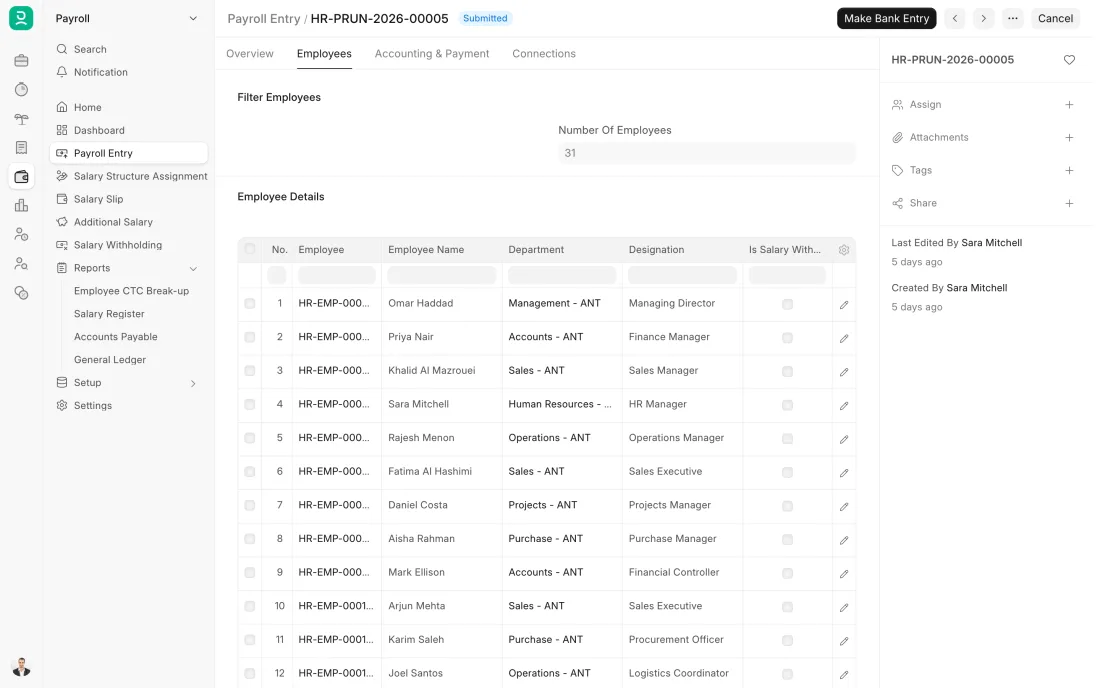
One Payroll Entry for the month creates a Salary Slip for every worker from their salary structure, with payment days taken from attendance. Approved overtime and shift allowances come in as extra earnings. Payroll can be run by department or branch, so each plant is checked by someone who knows it.
- Who does it
- Payroll officer
- Document that comes out
- Payroll Entry, Salary Slip
ERPNext then does this by itself
- Days absent without leave reduce the pay
- Approved overtime shows as its own earning on the slip
- An accrual entry posts the salary cost to the accounts
Without an ERP
Overtime is added to the payroll sheet from supervisors' notes on the last day of the month. Some hours are paid twice, some never, and every payday starts with a queue at the HR door.
ERPNext 16 · Payroll Entry -
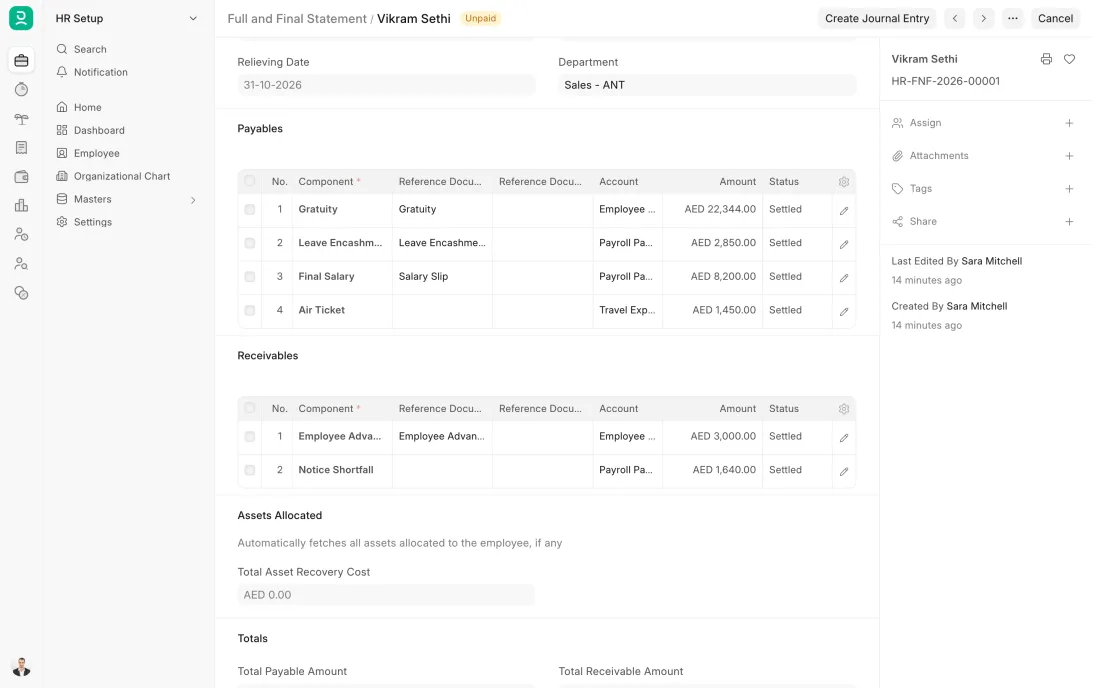
A Full and Final Statement gathers what the company owes, such as the last salary, leave not taken and end of service gratuity, and what the employee owes, such as an advance. Gratuity is worked out on a Gratuity document from the length of service, the salary and the rule you have set up. Gratuity rules depend on the contract and the place of work, so have the rule checked first.
- Who does it
- HR officer
- Document that comes out
- Full and Final Statement, Gratuity
ERPNext then does this by itself
- Company assets still held by the employee are listed
- Gratuity is worked out from the length of service and the rule
- Paying the settlement posts it to the accounts
Without an ERP
The final settlement is worked out by hand from three files. The gratuity is disputed, the advance is forgotten, and the employee waits weeks for money they are owed.
ERPNext 16 · Full and Final Statement
The Full map adds 11 more steps: the approvals, checks and branches between these.
A packaging plant runs two shifts. The roster moves a line operator to nights for a fortnight, the fingerprint device at the gate records each arrival, and the six overtime hours his supervisor approved are on his payslip at month end.
What changes in a manufacturing company. The same process, the steps this industry really uses.
-
Shifts are rostered, not assumed
Each worker has a Shift Assignment with a start and an end date. Rotations between day and night are planned ahead, and everyone can see them.
-
Attendance comes from the gate
Biometric devices can be set up to send every punch to ERPNext as a check-in. Nobody types attendance, and nobody signs in for a friend.
-
Overtime is approved, then paid
Hours beyond the shift show from the check-out time. The supervisor approves them, and only approved hours reach the payslip.
-
Joining includes safety
Safety induction and the issue of protective equipment are onboarding activities with an owner, so they are not left for a quieter week.
Where this map leads
Processes feed each other. Follow the work into the next map.
Free tool
Build your company's map
Pick your industry and the processes you run. Get one printable document with every map and step, ready to show your team or your ERP partner.
- Hire to retire
- Order to cash
- Purchase to pay
- Plan to produce
- Inventory management
Questions about hire to retire
Ask us anything elseCan ERPNext take attendance from a biometric device?
How is overtime handled in ERPNext payroll?
Can ERPNext handle rotating day and night shifts?
See this process run on your own data
A 45-minute ERPNext demo that follows this map with an example from your business.